


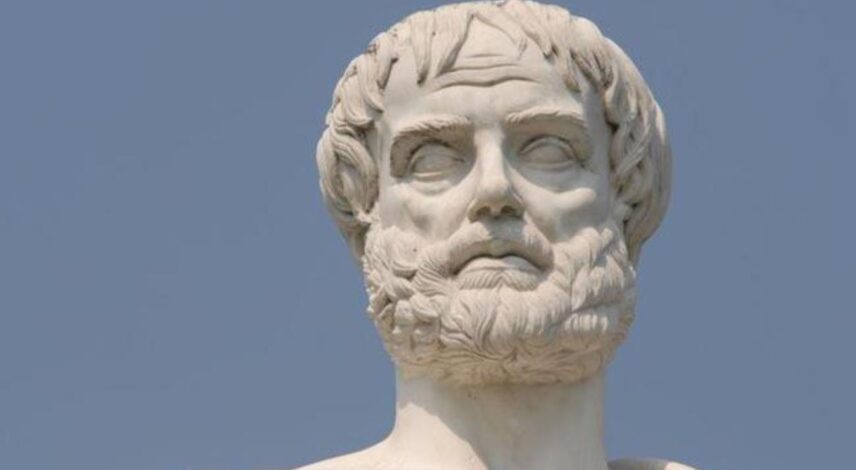

Aristotle was born in the year 384 BC. in Ancient Stageira of Halkidiki. Aristotle’s interest in biology was acquired by his father Nicomachus, who was a physician to the Macedonian king Amyntas III (father of Philip), as he sometimes helped him when he was young.
Aristotle was orphaned prematurely and his father’s friend Proxenos took over his guardianship. The Consul, who took care of Aristotle as his own child, sent him to Athens at the age of 17 (367 BC), to become a student of Plato. In the environment of the Academy, he amazed everyone and his teacher himself, with his intelligence and philanthropy.
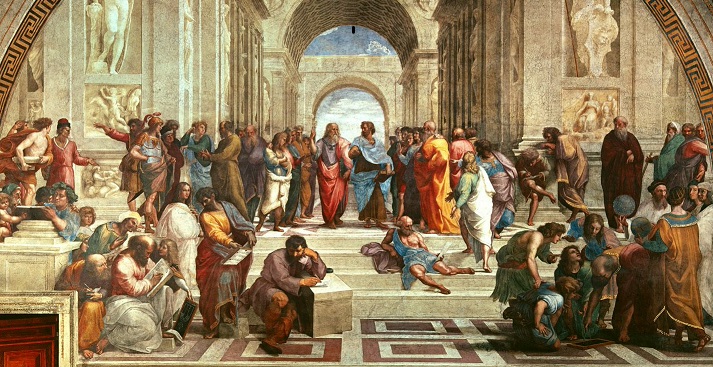 The “School of Athens”, fresco in the Apostolic Palace in the Vatican, by Raphael, depicting Plato’s Academy. Central figures: Plato and Aristotle.
When in 347 BC Plato died, Aristotle left Athens and settled in Assos, a city on the coast of Asia Minor, opposite Lesvos. Assos was then ruled by two Platonic philosophers, Erastos and Koriskos, to whom the ruler of Atarneas and old student of Plato and Aristotle, Hermias, had given the city. The two friends, governors of Assos, had founded a philosophical school there, as a branch of the Academy.
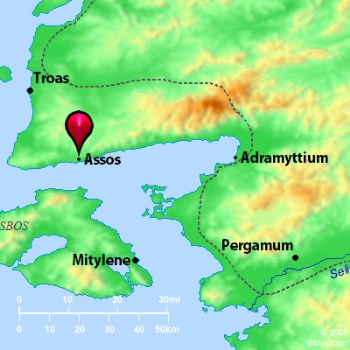

In Assos, Aristotle taught for three years and together with his friends he achieved what Plato could not. They were intimately connected with Hermias, and so influenced him that his tyranny became milder and more just.
In 345 BC Aristotle, crossed over to Lesbos and settled in Mytilene, where he taught until 342 BC. In the meantime he had married the biologist Pythiada, who was the niece and stepdaughter of Hermias, with whom he had a daughter who took her mother’s name. After the death of his first wife, Aristotle was later associated in Athens with Herpyllida from Stageira, with whom he had a son, Nicomachus.
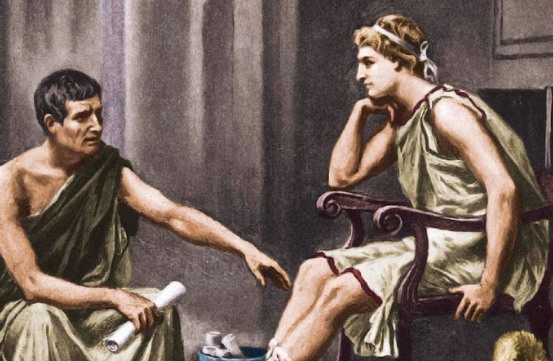 Ο Αριστοτέλης διδάσκει τον Αλέξανδρο
 Το 342 π.Χ. τον προσκάλεσε ο Φίλιππος στη Μακεδονία, για να αναλάβει τη διαπαιδαγώγηση του γιου του Αλέξανδρου, που ήταν τότε μόλις 13 χρονών. Ο Αριστοτέλης άρχισε με προθυμία το έργο της αγωγής του νεαρού διαδόχου. Φρόντισε να του μεταδώσει το πανελλήνιο πνεύμα και χρησιμοποίησε ως παιδευτικό όργανο τα ομηρικά έπη. Η εκπαίδευση του Αλέξανδρου γινόταν άλλοτε στην Πέλλα και άλλοτε στη Μίεζα, στη σημερινή Νάουσα της Μακεδονίας.
In 342 BC he was invited by Philip to Macedonia, to undertake the education of his son Alexander, who was then only 13 years old. Aristotle eagerly began the task of educating the young heir. He made sure to transmit the Panhellenic spirit to him and used the Homeric epics as an educational instrument.
Aristotle stayed in Macedonia for six years. When Alexander crushed the Theban resistance and restored peace to southern Greece, Aristotle went to Athens (335 BC) and founded his own school of philosophy. With money given to him in abundance by Alexander, Aristotle built the “Peripatetic school” with magnificent buildings
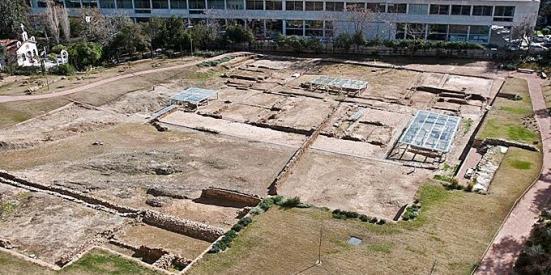 The Peripatetic School, as it survives today
The school was organized according to the standards of the Platonic Academy. Classes for advanced students were held in the morning and for beginners in the afternoon. The morning teaching was purely philosophical. The afternoon “rhetoric” and “external”.
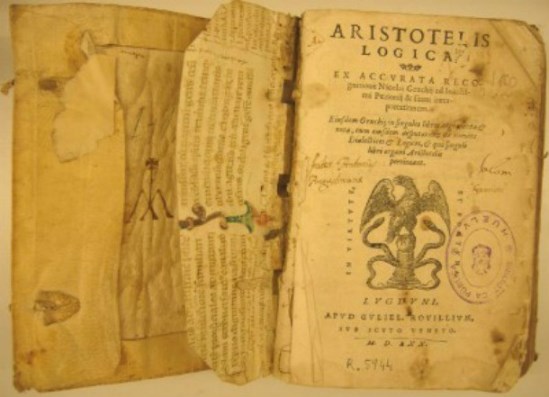 The school had a large library and was so well organized that it later served as a model for the founding of the libraries of Alexandria and Pergamum. Aristotle collected maps and instruments useful for teaching physics. So soon the school became a famous center of scientific research.
In 323 BC with the news of the death of M. Alexander, the followers of the anti-Macedonian party thought they had found an opportunity to take revenge on the Macedonians in the person of Aristotle. Aristotle, however, left for Chalkida, before his trial took place (323 BC), together with his second wife Herpyllida and his two children, Nicomachus and Pythiada.
Aristotle died in 322 BC. in Chalkida from a stomach ailment. His body was taken to Stageira, where he was buried with great honors. In his memory they established a festival, “Aristoteleia“, and named one of the months “Aristoteleio“. The square where he was buried was designated as the meeting place of the parliament.
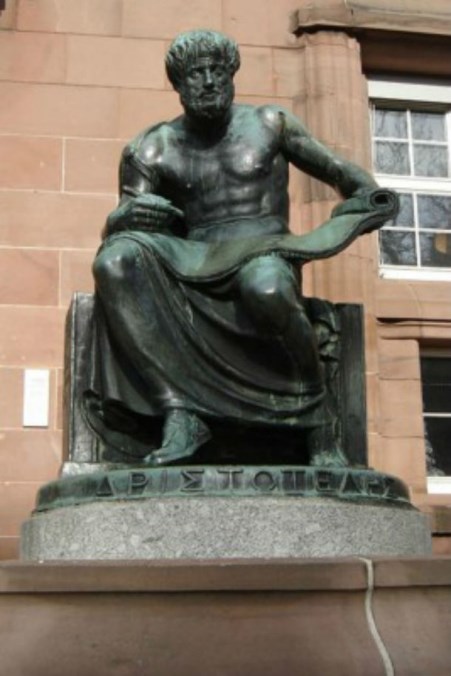
 Aristotle’s works refer to many sciences, such as physics, biology, zoology, metaphysics, logic, ethics, poetry, theater, music, rhetoric, politics, etc., and constitute the first comprehensive system in Western Philosophy.
He wrote many books and kept copious notes that helped him teach his students. Unfortunately, most have been lost and only 1/3 of his writings have survived.
Unlike his great predecessors Socrates and Plato, Aristotle introduced a new form of philosophy and teaching, in which he sought evidence.
Way ahead of his time, Aristotle believed that the universe was vast/eternal and that it had neither beginning nor end. He believed that when an object changes, its form changes, while its matter remains constant.
According to the Encyclopedia Britannica: “Aristotle was the first genuine scientist in history… and every subsequent scientist owes something to him…”
Hundreds of phrases and sayings are attributed to Aristotle, but here we will host only a few of them:
- Greatness of spirit is accompanied by simplicity and sincerity.
- Criticism is something we can avoid easily by saying nothing, doing nothing, and being nothing.
- He who cannot be a good follower cannot be a good leader.
- It is our choice of good or evil that determines our character, not our opinion about good or evil.
- Courage is the first virtue that makes all other virtues possible.
- The weak are always anxious for justice and equality. The strong pay no heed to either.
- Life is only meaningful when we are striving for a goal.
