


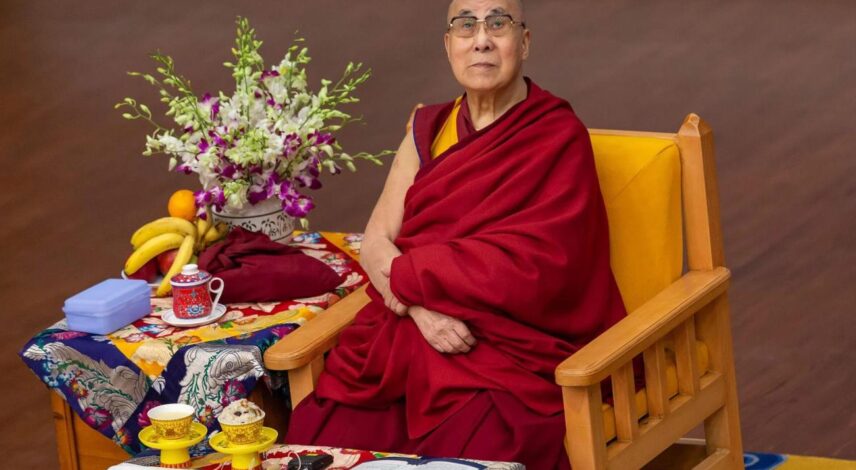

Dalai Lama is the title given to one of the two leaders of Lamaism (Tibetan Buddhism) (the other leader being the Panchen Lama). The name “Dalai Lama” is a combination of the Mongolian word “Dalai” meaning “ocean” and the Tibetan word “bla-ma” meaning “guru – teacher“.
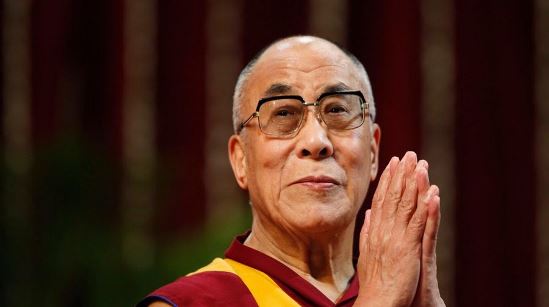
The Dalai Lama was the political leader of Tibet until 1950. It is considered to represent on earth the living incarnation of the Bodhisattva Avalokiteshvara, who is one of the forms of the Buddha and specifically the form of mercy.
The Dalai Lama’s spiritual jurisdiction extends beyond Tibet to Mongolia, a part of China, and the Kingdoms of Bhutan and Sikkim. Until 1959 the seat of the Dalai Lama was the Tibetan capital, Lhasa. In 1959, when the Chinese occupied Tibet, the Dalai Lama fled to India. After the death of the Dalai Lama his successor is elected in the person of the child, who is born at the time of his death and who, as the Lamas claim, recognize in this child some signs that show that he is the new incarnation of the Buddha Avalokiteshvara.
The Lama sect is a relatively new religion founded in the 15th century by the Buddhist master Tsongkapa, whose third successor was recognized by the Mongols as the ruler of Tibet. The 14th Dalai Lama announced on 10 March 2011 his intention to step down as political leader of the Tibetan government-in-exile.
According to the Lamaists, His Holiness Tenzin Gyatso is the 14th Dalai Lama. He is the longest serving in this position. He won the Nobel Peace Prize in 1989, and is also known for his lifelong advocacy for Tibetans inside and outside Tibet.
The Dalai Lama was born on July 6, 1935 in Takcher, Qinghai, and was chosen to succeed the 13th Dalai Lama Thumpten Gyatso two years later, although he was officially recognized as the 14th Dalai Lama on November 17, 1950, at the age of 15.
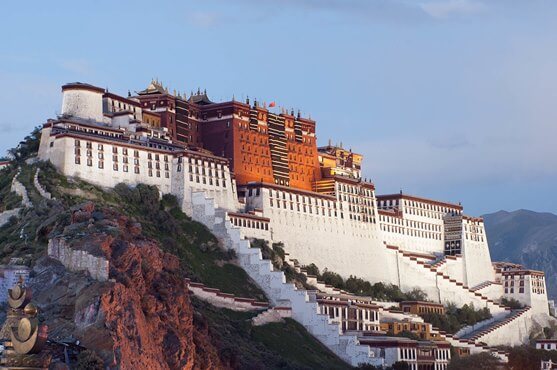
During the 1959 Tibetan uprising, the Dalai Lama fled to India, where he denounced the People’s Republic and established the non-governmental Central Administration of Tibet. He has traveled the world advocating for the welfare of Tibetans, teaching Tibetan Buddhism and speaking about the importance of compassion as a source for a happy life.
All over the world, institutions face pressure from China so that it is not accepted. He has spoken on the environment, the economy, women’s rights, nonviolence, interfaith dialogue, physics, astronomy, reproductive health, and sexuality, along with various Mahayana and Vajrayana topics.
Other quotes of his are (among hundreds):
- Once a year, go someplace you’ve never been before.
- Κnow the rules well, so you can break them effectively.
- Share your knowledge. It is a way to achieve immortality.
- As you breathe in, cherish yourself. As you breathe out, cherish all beings.
- Sleep is the best meditation.
- Judge your success by what you had to give up in order to get it.
- Happiness is not something readymade it comes from your own actions.
- Give the ones you love wings to fly, roots to come back and reasons to stay.
- The goal is not to be better than the other man, but your previous self.
- Our prime purpose in this life is to help others, and if you can’t help them, at least don’t hurt them.
- The true hero is one who conquers his own anger and hatred.
