


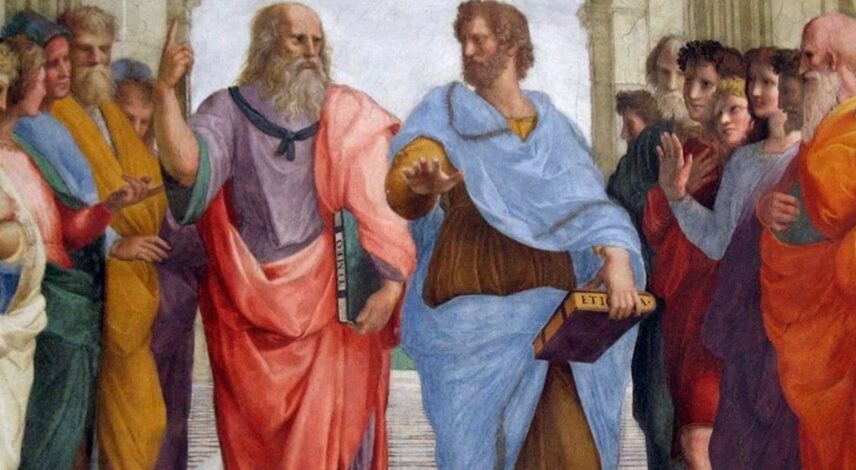

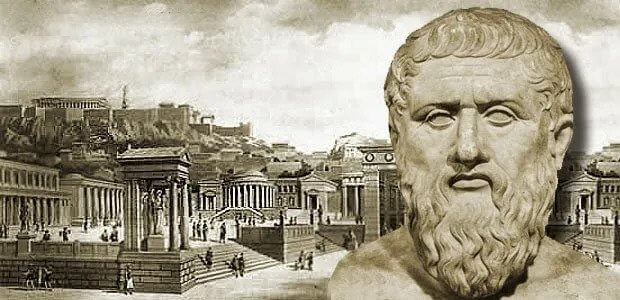
Plato (427 – 347 BC) was an ancient Greek philosopher from Athens, the most famous student of Socrates and teacher of Aristotle. His work, which has survived in the form of philosophical dialogues, exerted a huge influence on ancient Greek philosophy and in general on the Western philosophical tradition until today.
Plato, among others, wrote the Apology of Socrates, the Symposium where he talks about the nature of love, “Protagoras” where, among other things, the principle of “prevention” is theoretically founded where he does not consider punishment as absolutely “retributive”, while in in two long dialogues, the State and the Laws, he described an ideal state, a three-class society:
- Governing (Rulers or Philosopher Kings) – those who are intelligent, rational, self-controlled, in love with wisdom, well suited to make decisions for the community. These correspond to the “reason” part of the soul and are very few.
- Protective (Warriors or Guardians) – those who are adventurous, strong and brave; in the armed forces. These correspond to the “spirit” part of the soul.
- Productive (Workers) – the labourers, carpenters, plumbers, masons, merchants, farmers, ranchers, etc. These correspond to the “appetite” part of the soul.
His body of work often ranks him among the world’s leading and most influential figures of all time, along with his teacher, Socrates, and his student, Aristotle.
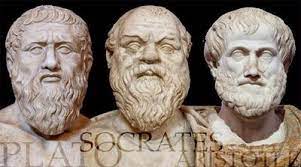
Plato met Socrates at the age of 20 and remained close to him until his death in 399 BC. After the death of Socrates he remained in Athens for about three years and then took refuge in Megara, close to his classmate Euclid and other Socratics. Then he returned to Athens, where for 10 years he was engaged in writing philosophical works, which bear the stamp of Socratic philosophy.
It is then speculated that he traveled to Egypt and Cyrene, where he became involved with the mathematician Theodore, however the evidence we have about this trip is considered to be uncertain. On the contrary, there is certainty about his travels in Sicily and Southern Italy. In Taranto in 387 BC he met the Pythagoreans, by whose philosophical thought he was decisively influenced.
At the court of the king of Syracuse, Dionysios the elder, he met the royal brother-in-law Dionas, with whom he became friendly. But this friendship aroused Dionysius’ suspicions of a conspiracy, which is why he expelled Plato from Sicily. In Aegina he was taken to be sold in a slave market where his Cyrene friend Annikeris bought his freedom.
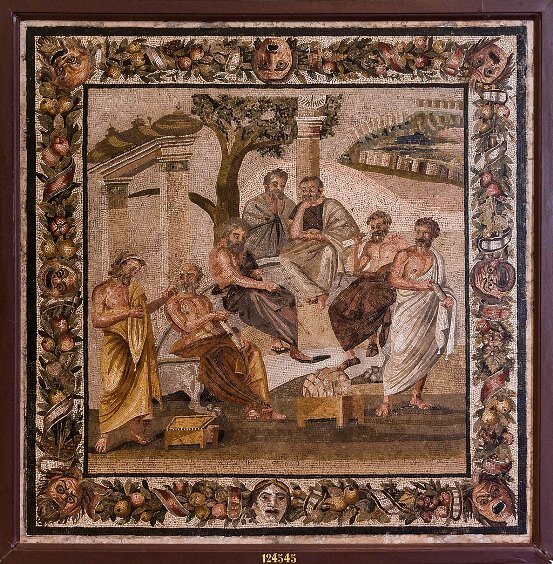
Returning to Athens he founded his philosophical school, the Academy (c. 387 BC). In 367 BC Dionysios II the Younger succeeded Dionysios I in power. At the prompting of Dionas, Dionysios B’ invited Plato as his advisor and he accepted the invitation in the hope that he would implement his political ideals.
He traveled to Syracuse in 366 BC, but soon fell out with the king’s other advisers. Dionas was exiled and Plato remained at the court of Dionysius as a guest and prisoner until 365.
For the third time he came to the court of Syracuse in 362 BC, after the reconciliation of Dionas with Dionysius, however, new frictions between them led Plato to the decision to leave Syracuse in 361. He returned to Athens where he worked until his death by teaching and by writing philosophical works.
Until the 1st century BC, under the direction of Antiochus of Ascalonite, the Academy was the center of Platonic philosophy. In the ancient biographical sources there are mixed judgments about the character of Plato, as in some he is presented as wise and divine, while others describe him as a proud and jealous servant of tyrants, who wrongly designed the image of Socrates and the sophists.
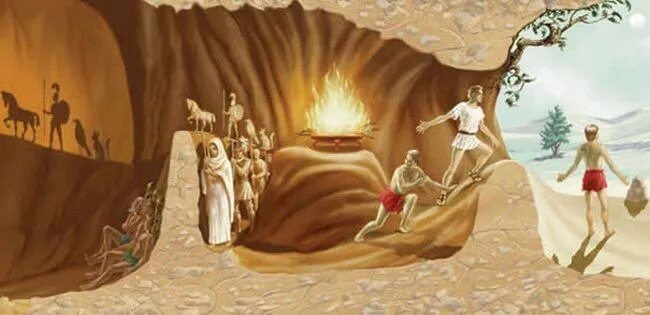
Platonic philosophy is dualistic, dividing the world into a material and an ideal realm of existence. This is done by introducing the theory of ideas, which according to Plato are the eternal archetypes of sensible, material things, transcendental forms that are perceived only by reason and not by the senses. He considers sensible objects to be inferior, material and perishable images of the ideas that shape them.
Plato therefore recognizes two different worlds, the perceptible world, which is constantly changing and is in an unstoppable flux, according to Heraclitus, and the imaginal world, the unchanging one, i.e. the ideas, which exist in a heavenly place. These are the archetypes of the visible world, the eternal patterns and models which sustain the form of the underlying material bodies. In other words, it is a dualistic, hierarchical metaphysical system.
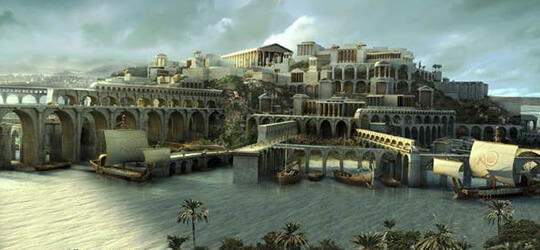
Myth of Atlantis: Two of Plato’s dialogues Timaeus and Critias refer to Atlantis and the cataclysm that destroyed it. Plato describes to Critias the civilization of Atlantis and its capital, Poseidonia. He writes that it was larger than Libya (Africa) and Asia combined.
The knowledge on the subject of the once admired continent is attributed to Solon, who in turn had obtained it from the Egyptian Priests. The phrase of the Egyptian Priests at Solon has remained famous: “Solon, Solon, you Greeks are eternally children… all that you said before… is little different from children’s tales, because you remember only one deluge of the earth, although previously they have become many“. The Priests told Solon that they had records of events that happened thousands of years ago. They tell him what happened, referring to what was recorded in the Holy Books.
The end of Atlantis was decided by Zeus. Zeus concluded that a good people had taken very bad directions and wanted to punish them, so that they would be punished and become more regular. Concluding the account contained in Timaeus, the priests refer to the flood: “After the lapse of a considerable time, however, there were terrible earthquakes and floods, and within one terrible day your whole army was buried in the earth, and the island of Atlantis disappeared submerged in the sea, for this both destitute and unexplored became the ocean there…”
Plato died peacefully at the age of 81.
Hundreds of phrases and sayings are attributed to Plato, but here we will host only a few of them:
- This City is what it is because our citizens are what they are.
- He who steals a little steals with the same wish as he who steals much, but with less power.
- Let parents bequeath to their children not riches, but the spirit of reverence.
- He who wants to become excellent must not love himself more, not his own, but the righteous.
- As masons say, big stones don’t stand well without smaller ones.
- Too much freedom is like too much slavery, since it changes both the citizen and the state.
- What is worth living is not living to get more but living well.
- Wise men talk because they have something to say; fools, because they would like to say something.
