


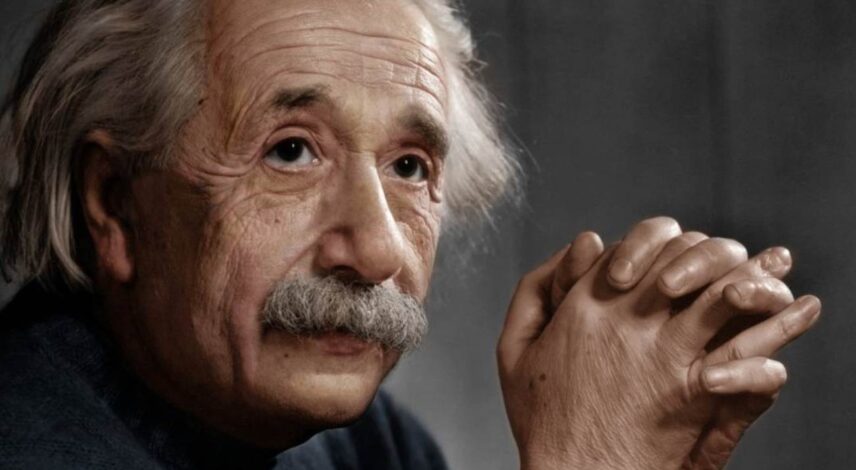

Albert Einstein was a German physicist of Jewish origin who was awarded the Nobel Prize in Physics in 1921 for his services to the world of physics.
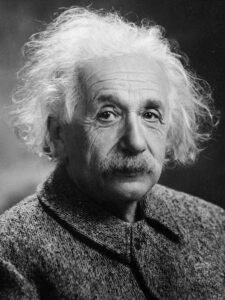
He is the founder of the Theory of Relativity and is considered by many to be the most important scientist of the 20th century and one of the greatest of all time.
He published over 300 scientific publications, as well as 151 writings for the general public.
Albert Einstein developed a series of theories that proclaimed, for the first time, the equivalence of mass to energy while at the same time giving completely new content to the concepts of space, time and gravity.
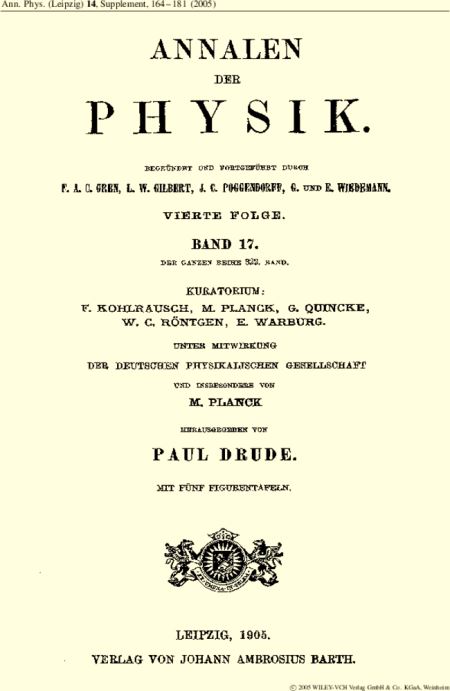
In 1905 he published four articles in the German scientific journal Annalen der Physik. In the first of four papers he gave the explanation of the photoelectric effect, for which he was awarded the Nobel Prize in 1921.
He relied on the quantization hypothesis which had been introduced a few years earlier by Max Planck to explain blackbody radiation. These two papers by Planck and Einstein formed the beginning of quantum mechanics.

Einstein later opposed quantum theory because he could not believe that the laws of physics could contain randomness. In his own words: “God does not play dice with the universe”
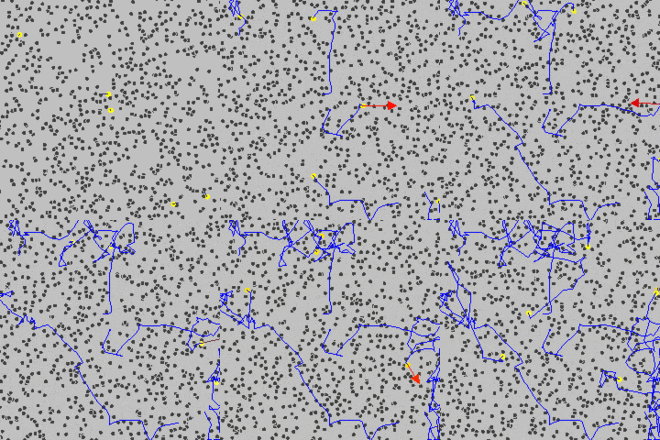
In his second article he dealt with the Brownian motion. Brownian motion is the random motion of microscopic solid particles in a body of liquid, due to collisions of the particles with the molecules of the liquid.
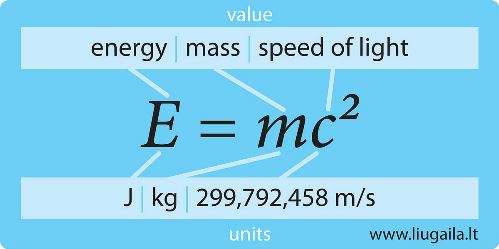
In the third of the articles he published in 1905 he formulated his theory of the movement of light. He argued that the speed of light movement is independent of the position and movement of the observer and constant for a given medium of propagation (eg vacuum, water, glass).

In the fourth article he showed that from this the equivalence of mass and energy was deduced, giving the famous formula . These two articles form the core of the special theory of relativity.

In November 1915, Einstein presented his general theory of relativity in a series of lectures before the Prussian Academy of Sciences. According to it the attractive force of gravity spreads through space at the speed of light and affects everything in space, even radiation. The latter makes possible the existence of black holes, a phenomenon that was observed much later.
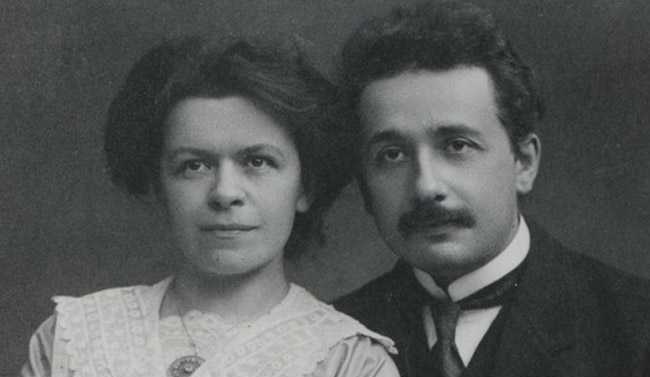
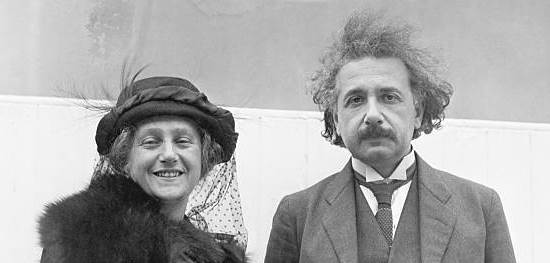
In 1903, Albert Einstein married his fellow student Mileva Marić, with whom he had two children, Hans Albert and Eduard, while he also had a daughter with her, Lieserl, whose fate is unknown. In 1919, after his divorce from Mileva, he married his cousin, Elsa.
Einstein was a champion of socialism and a fanatical critic of capitalism. In his book “Why Socialism?” expresses his political beliefs.
When Einstein died in 1955, scientists wanted to know what made him so smart. So they removed his brain to study it and discovered that the part of the brain responsible for mathematics was unusually large in his own mind.
Άλλα δικά του αποφθέγματα είναι (ανάμεσα σε εκατοντάδες):
- Life is like riding a bicycle. To keep your balance, you must keep moving.
- Try not to become a man of success. Rather become a man of value.
- Creativity is intelligence having fun.
- Anyone who has never made a mistake, has never tried anything new.
- Blind belief in authority is the greatest enemy of truth.
- Logic will get you from A to Z; imagination will get you everywhere.
- The measure of intelligence is the ability to change.
- A clever person solves a problem. A wise person avoids it.
